I’m An Adult Child – part 1

Living life from a basis of fear

Comparing myself to others

Never thinking it was safe to play

Surrounded by people who didn’t respect me or treat me well

Afraid of authority figures and tending to isolate myself

Frightened by angry people and any personal criticism

Feeling overly responsible for others as a way to avoid looking at my own faults

Being my own Harsh, Harsher, and Harshest judge and critic

Feeling tremendously guilty when I stand up for myself instead of giving in to others

Addicted to excitement in its myriad forms

Stuffing feelings, and not even able to remember or feel what they are now

Continuing to live with sick people who were never there emotionally for me in order not to be abandoned.

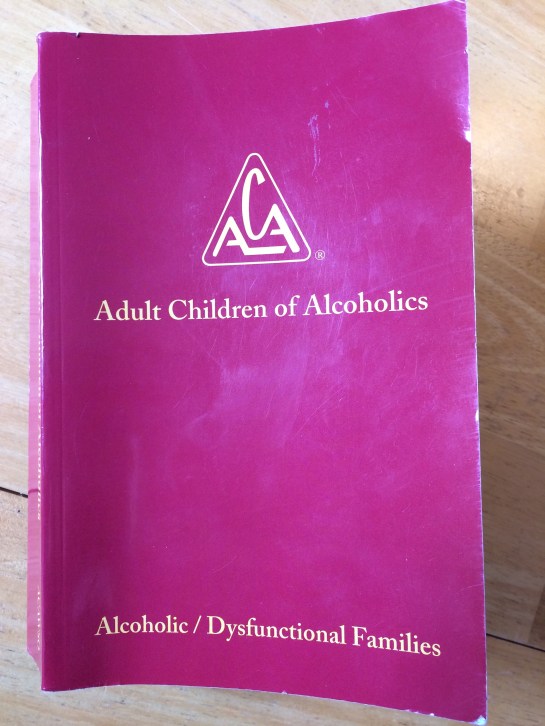
Yes, Yes, Yes, and Yes. I recognize myself when I read the Laundry List –  14 Traits of an Adult Child. And when I introduce myself at an ACA meeting, ‘Hi, I’m Robin, an adult child,” I’m embracing a reality I have always lived and struggled to hide and accept.

The Red Book has 648 pages, so it can’t be summed up in a paragraph here. What I’d like to do is offer a few bits and pieces as I work through them. Right now I’m working on reparenting myself: learning to be sensitive to my needs and my background experience. For me, I need a lot of validation – that my feelings make sense given my family history.

I encourage myself in many ways. For example, I remind myself when I start to slip into that spiral of self-doubt and condemnation that I’m actually doing a pretty good job; that I am not a bad person; that I have something valuable to share with the world. I repeat Lady Gaga’s words to my hurting hating Self, “You’re on the right track, baby! God makes no mistakes.”

I also tell myself that growth doesn’t happen in the blink of an eye. Patience, my dear! I sing songs with empowering messages, take time at the water’s edge, and share my experiences with trusted friends both in and out of the program.

And like Joe Walsh, I’m taking it One Day at a Time.

IMG_3029


Adult Children

ACA is a 12-Step program for Adult Children of Alcoholic/Dysfunctional Families. I joined a local group in January 2016. We meet once a week for about 75 minutes, and we’re all women.  When I first walked in, I felt I was home. Part of it was the warmth of the room’s furnishings: sofas, big comfy chairs, big windows and a lot of light. Part of it was that the women there had been meeting for 25 years, and there was a peaceful practice of acceptance in place that I could feel immediately. But really, the biggest part was that I knew on some level before even opening my mouth or hearing anyone open theirs, that this was a safe space- a place to explore and discover my Self.

The first thing that struck me about the meeting was that no one said a word while someone else was talking. There was absolutely NO CROSSTALK. I was a little uncomfortable about it. I’m used to nodding my head, saying ‘Uh-huh!’ or ‘Really?’ and making eye contact with the speaker, at the very minimum. More often, I like to give my feedback, my Two Cents. In this room, the speaker takes her turn when she’s ready, breaking the silence to say her name and be greeted. After that, no one offers any comment. We just sit and listen. And we Thank her when she’s done. That’s all. Then we return to silence.

The term ‘crosstalk’ means interrupting, referring to, commenting on, or using the contents of what another person has said during the meeting. Many ACA members come from family backgrounds where feelings and perceptions were judged as wrong or defective.  When we were growing up, no one listened to us; or they told us that our feelings were wrong. As adults, we are accustomed to taking care of other people and not taking responsibility for our own lives. In ACA we speak about our own experiences and feelings, and accept without comment what others say because it is True for Them. We work toward taking more responsibility in our lives rather than giving advice to others.

In ACA, we do not touch, hug, or attempt to comfort others when they become emotional during a meeting. If someone begins to cry or weep, we allow them to feel their feelings. We support them by refraining from touching them or interrupting their tears with something we might say. To touch or hug the person is known as ‘fixing.’ We learn to listen, which is often the greatest support of all.

I’ve come to cherish the ‘no crosstalk’ rule. It’s still a challenge for me to remain silent but I’m getting more comfortable with sitting in silence. And I have experienced first-hand how effectively freeing and validating that silence is. There is nowhere else in my experience where I can share what’s on my heart without being interrupted, interpreted, advised, judged, or in some other way verbally responded to, even positively, with questioning or other kinds of feedback. The silence of the group around me is a reward in itself, and I know I have been heard.

FullSizeRender

Birthing another kind of Baby – Making Paper Art

fullsizeoutput_3978

I’m crouching down on my knees, looking back and forth from the ‘canvas’ on the floor in front of me to a scattered pile of colored paper clippings and magazine cut-outs off to the side. Each of these little shreds of paper seem precious. In fact, I carried an envelope filled with them back with me from my recent trip to Belgium. If I find one left behind on the carpet after cleaning up, I pick it up gently and put it back in the pile. Who knows where it’s intended to go in the future?

Today, I’ve just finished ‘mid-wifing’ a birth. This thing has a life of it’s own. I’m just assisting, putting puzzle pieces together, like it’s already been prepared and my job is to figure out where they all go. It’s FUN.


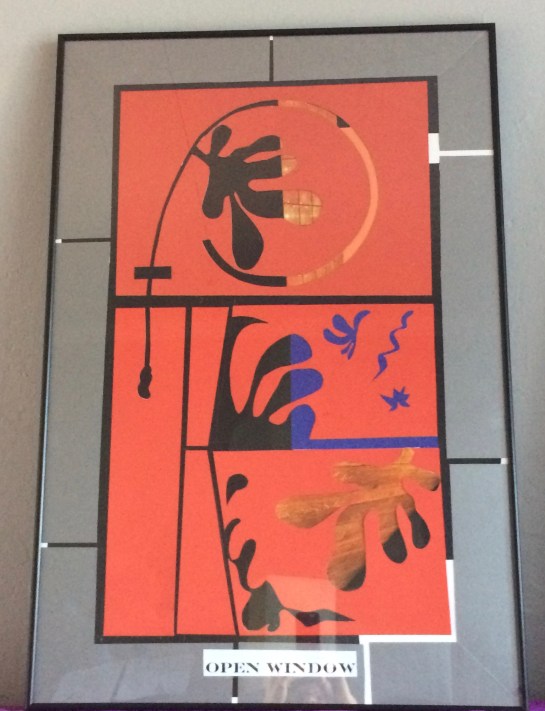
Lately I’ve been copying things I like from the masters. Each time I learn something. Isn’t that how artists start? We certainly don’t create in a vacuum. I take something I like and add something new. Steal like an artist! My new baby (on the right) is inspired by one of my favorite artists, Henri Matisse. His later work was done from bed, where his primary tools were scissors and brilliant colored paper. This one (above, left) was done in 1951, the year I was born. I copied some of his cutouts almost exactly. Can you see which ones?  Do you think Matisse would like the way I used his shapes? I’m sorry I can’t ask him, but I think he would.


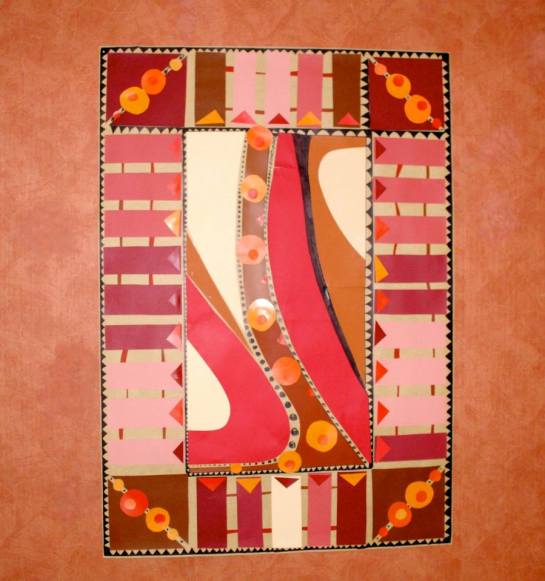
This is my very first paper project from 2013. The one on the left was tacked to the wall in our bathroom in Belgium, where it looked really nice. However, when I saw it again on my recent visit, I couldn’t bear to leave it behind, so I rolled it up and brought it back (no small task cuz it’s pretty big.) I added a border to fit the frame. Better?  Worse? I’m not sure. They’re different!

Paper Art project 4

Paper Art- Project 2, Belgium 2013

This one (above) is still hanging in the living room in Liege. It was too fragile to move. My second paper cut-out project, it came at a period when I was immersed in all things Pucci.

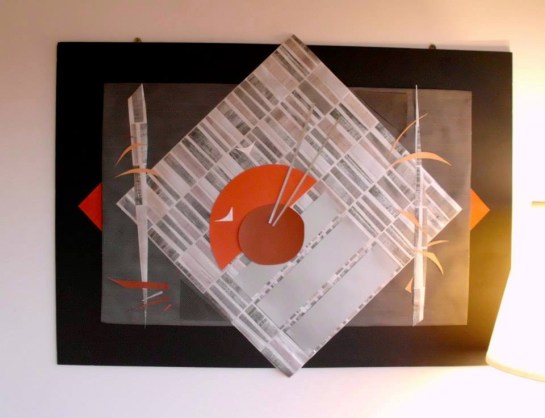
Paper Art 2 - Rice Bowl

Rice Bowl – Project 3, 2013

The idea for Rice Bowl must have originated somewhere in Korea while I was there. The wallpaper sample had an oriental look, and the rest just happened. Looking at it I can recall sitting in a cozy Korean ‘Chuk’ restaurant, playing with my chopsticks, listening to Asian music and savoring the taste of red pepper paste.


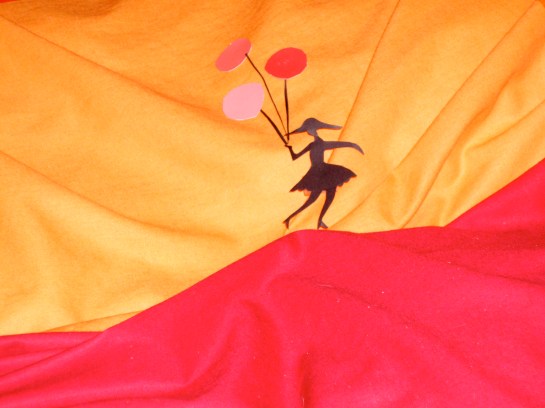
WONDER WOMAN: a piece of black construction paper and a pair of scissors in my hand, I was wondering what to do for a design project that week. I had no conscious ideas until I saw her. She seemed to create herself.

Design 1

She didn’t hesitate to jump up and ask for a photo shoot. I had to scramble around to satisfy her.  She was all energy and dragged me around the house in a flurry of excitement.

I like the creative process best when I don’t get into second-guessing. When I’m in the flow, I don’t even have to ask myself,  ‘What am I creating?’ I just get down close and watch.  The focus is deep, relaxing, and energized, and like wonder woman, I’m all over the place and so is the stuff on the floor. It’s a visual, organic experience. That part is what I really like~ there’s very little rational or mental work going on. From the GUT is where the baby comes. I’m discovering her as she develops. I have no idea what she’s going to look like, or when she’s going to say, “I’m done!” I often feel like an innocent bystander clapping my hands when it’s all over shouting, “Wow! Oh, wow!”

These are my babies, and I love them, but it’s not like I can say I created them. Yes, I put in some raw ingredients. In the case of my daughter, I put in my egg, my husband put in his sperm, and then we sat back and watched as a baby took shape. When she finally appeared, we said, ‘Wow! Incredible! Who are YOU? Where did YOU come from? You’re not like anything we’ve ever seen. You’re one of a kind, that’s for sure, and you’re absolutely beautiful! We love you!’

IMG_2390

“My Mission Statement!” – 2013

It was great to make a wall hanging that reminds me what’s important, what makes me happy. I took a picture of this one before leaving Belgium, so I can make another one now that I’m in back in the States.

I’m going to run out today and look for another frame. With a frame in front of me, at least I know what size the next baby’s going to be. Everything else will be a surprise.

fullsizeoutput_c2a

Self-portrait, 2013


Thank you for Asking!

This is not a new survey. It’s been 3 1/2 years since I completed a survey of Unificationist Sunday Services as they are experienced by various members around the world. It was my first research project. I was inspired by the qualitative research of Brene Brown (The Power of Vulnerability), and dealing with a lagging interest in attending a service 90 minutes from home. I was also frustrated that my experience and that of my husband wasn’t part of the conversation. I wanted to find out what others had to say.

Engrossed thoroughly as I was in reading the responses as they came in, the work pulled me through a tough winter in Belgium, and helped me tap into a passion I’ve had all my life: giving voice to the silent or the unheard.  Grassroots stories from the field always catch my interest. All told, I logged in over 600 hours, spanning a period of 3 months. The people who responded had something to say and were glad to be asked.

The finished survey was sent out to everyone who had participated, and then published on the Applied Unificationism blog, but that was as far as it went. This week, I went back for the first time, and realized it might be time to make the website public. For anyone out there who’s interested or involved in similar research,  I hope it is edifying and finds fertile soil in your garden as well.

FOOD for Thought

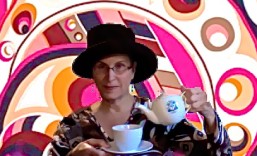
womanofpeace's avatarTEA TALKS with ROBIN

0310150717-01 I just want to say before starting this post that there are 3 things my food is all about:
1) healthy
2) tasty
3) beautiful

I always start with healthy ingredients. No additives like food coloring, preservatives, or chemical substitutes. This means for the most part using unprocessed food, and making it yourself. The good news is that it’s easier than it sounds.
The tasty part is secondary, because I actually don’t use much in the way of seasonings. I learned a long time ago that simple food tastes good all by itself. I don’t need lots of sauces or dressings to make it yummy. But if you do, just add it yourself afterwards!
The third part is the beauty part. If you use whole foods, you’ll end up with something beautiful to serve, and arranging things to look elegant in a bowl or on a plate is an art-form…

View original post 656 more words

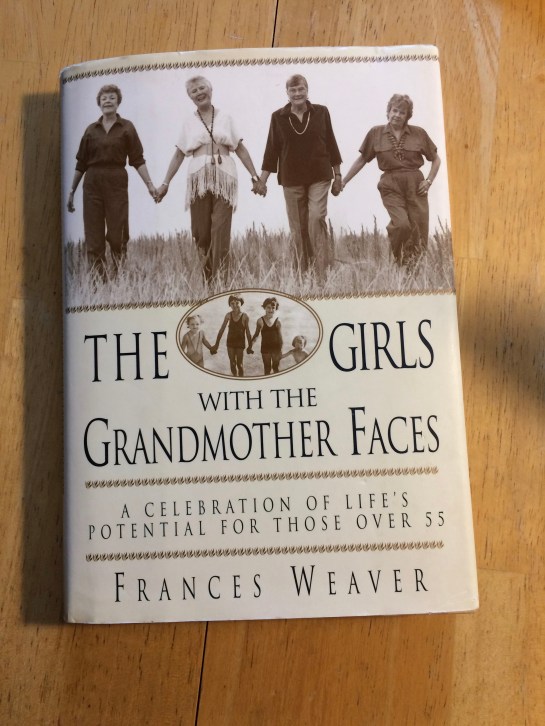
The Girls with the Grandmother Faces

I found this book in a box in Belgium when I went home to sort through the things I’d left behind three years ago. I don’t remember where I got it, but I hadn’t read it yet, and the cover looked intriguing and right up my current alley, so I took it with me on the plane back to the US. I’d like to introduce it to my over 55 friends, men included. Although it’s written especially for women, any one of us older folks can benefit from the ideas Frances Weaver writes about.


Right off the bat, I’d like to say something that has seriously stuck with me ever since reading it last week: We older women are no longer the center of our grown children’s lives! That was a bombshell. What? How could that be?? Frances tells the story of how after her husband died, she sold the big house and moved closer to her children, expecting them to gravitate around granny for all the holidays and vacation times. Wrong.  She waited and waited, and when all she got was excuses, she decided that it was time for her to live her own life, not theirs.

I have to admit this was a shocking and revelatory idea for me. A few days later I was visiting my daughter for the weekend and happened to spy her diary on the floor half under the bed. Against the chiding of my conscience, I picked it up and leafed through it, searching for any mentions of my name. Yes, I wanted to prove to myself how important I am to my daughter. I was expecting to read things like: My mom said this, and I was so inspired; My mom did this, and I was so inspired; My mom my mom, my mom…..you get the picture. I couldn’t find one mention of my frequent presence in her life, and realized that Frances was right. Thinking back to my own journals, how often was I quoting my mother or waxing poetic about her? Unless it was something extremely negative, she wasn’t in there very often. I had other things to write about. I was living my life, not hers.

They say we have to let our children go, spread their wings, fly the coop. I am reminded of Kahlil Gibran’s poem, On Children:

Your children are not your children.
They are the sons and daughters of Life’s longing for itself.
They come through you but not from you,
And though they are with you yet they belong not to you.

You may give them your love but not your thoughts,
For they have their own thoughts.
You may house their bodies but not their souls,
For their souls dwell in the house of tomorrow,
which you cannot visit, not even in your dreams.
You may strive to be like them,
but seek not to make them like you.
For life goes not backward nor tarries with yesterday.

You are the bows from which your children
as living arrows are sent forth.
The archer sees the mark upon the path of the infinite,
and He bends you with His might
that His arrows may go swift and far.
Let your bending in the archer’s hand be for gladness;
For even as He loves the arrow that flies,
so He loves also the bow that is stable.

The best thing I can do for Emilie at this stage in both of our lives is to be that stable bow, and to encourage her to fly while I do the same! Having come to that realization, I understand her response to my recent FB post about being 66 and feeling so happy about my life. She said, “Mom! I want to be like you when I’m 66!” No sweeter words necessary!

Back to The Girls with the Grandmother Faces, A Celebration of Life’s Potential for Those Over 55: A second big takeaway is that when we are older and find ourselves with more time on our hands, we need to “get back out there among ’em, drop the safety net, and move on our own steam.” Here are a few more quotes along those lines:

“Our world has more for us to do than we have imagined. Until now, we hadn’t the time, but now that’s pretty much all we have….With our eyes and ears open, we can find new and marvelous things to do, then pass the magic along to other women like us.” She’s talking about going back to school, getting involved in community activities, travel during off-seasons, and taking advantage of all the many senior advantages available. One of the things Frances took up (at the age of 55) was kite flying. It became an obsession, and she found others who enjoyed it too, and has a collection of kites and kite-flying friends from all over the world. Who would have thought of that?

She’s speaking directly to where I am at these days- wondering what to do with my time? I’m getting the idea from her that before I go out looking for a ‘regular’ job, I should try my hand at something creative that I’m already doing and loving. The author’s story is just such an example. After she became widowed, she booked a thirty-day cruise. Never having traveled by herself, she felt the need to find out if she could. She had so much fun, and felt so good, that she began helping a travel-agent friend sell group tours in return for an agent’s rate, and created a temporary job for herself as tour director. Then she went back to community college, which included a move clear across the country, and took Creative Writing, Poetry, and Spanish. Finding that she liked to write, and against the admonitions of her less adventurous friends, she self-published the “Grandmother Faces” book. Shortly after putting copies in her local Colorado bookstore, she was invited by a Denver publisher to write a travel book for older single women (like myself), which she did. It’s called, This Year I Plan to Go Elsewhere. It’s on my reading list!

Next, she was interviewed on a nationwide cable channel, and somehow or another, the department of tourism in Malta invited her to spend a week in Malta, all expenses paid! She was subsequently hired by a cruise ship line to be a guest lecturer, and for the next 10 years traveled all over the world. Reading her story has been electrifying. It sounds like the perfect scenario: travel, creativity, writing and speaking, and meeting all sorts of people.

I’m not divorced or widowed, but I’m living alone per an arrangement that is working well for both me and my husband of 35 years. Both of us are having to rethink and recreate our lives, and learn to live what we have left of our lives in a satisfactory and inspiring way. We are each learning to make and trust our own decisions. Having no one else to blame helps. Creative living requires an amount of risk-taking, but what’s to lose? “One risk often leads to greater discoveries of our own capabilities,” Frances writes. That’s been my experience, for sure. I’m thinking of a recent risky behavior I embarked on when I responded to an add on Craig’s List looking for a backup vocalist for a local musician. Thrilled and terrified at the same time, I picked up the phone and made the call. We agreed to meet at the open mic a few miles down the road, and both signed up to perform separately so we could appraise each other’s musical talents before deciding to work together. I had no idea what he would look like, nor did he have a clue that I was 65. That in itself was one of my biggest fears – that he would reject me immediately because of my age. It turned out that his music was deplorable, and his personality not much better, and he left the bar without saying anything, which was a relief. On the other hand, I had a good set, and realized I can do this performance thing still, even at my ripening age, and I met a fantastic bass player in the process.

“Recycling ourselves means getting rid of whatever serves no useful purpose, whatever our lives no longer depend on. Recycling also means discovering the unused, still-new interests, options, and opportunities that did not fit the younger version of ourselves.” Yes! My parents are both gone, and I was lucky I didn’t end up being saddled with their long-term care as many boomers are finding themselves. My daughter is a grown woman, and has left the nest. She’s making decisions for herself, and I have been learning to trust that she can take care of herself now and doesn’t need me sticking my nose into everything. I’ve got my health, and I’m basically free at this stage of my life. I don’t want to waste the precious time!

I’d like to suggest this book to anyone who has recently found themselves facing a new phase in life, wants to make a new start and needs some direction, or is feeling old and tired and knows there’s more if they could just figure out what.  A final quote that sums it all up for me comes from Jane O’Reilly, New York Times, July, 1986: “The most important mission of a woman’s life is not to hold onto her looks. Our mission is the same as a man’s….to grow up.” Yes. And no one else can do that for us!fullsizeoutput_3938